


Aug. 13, 2025

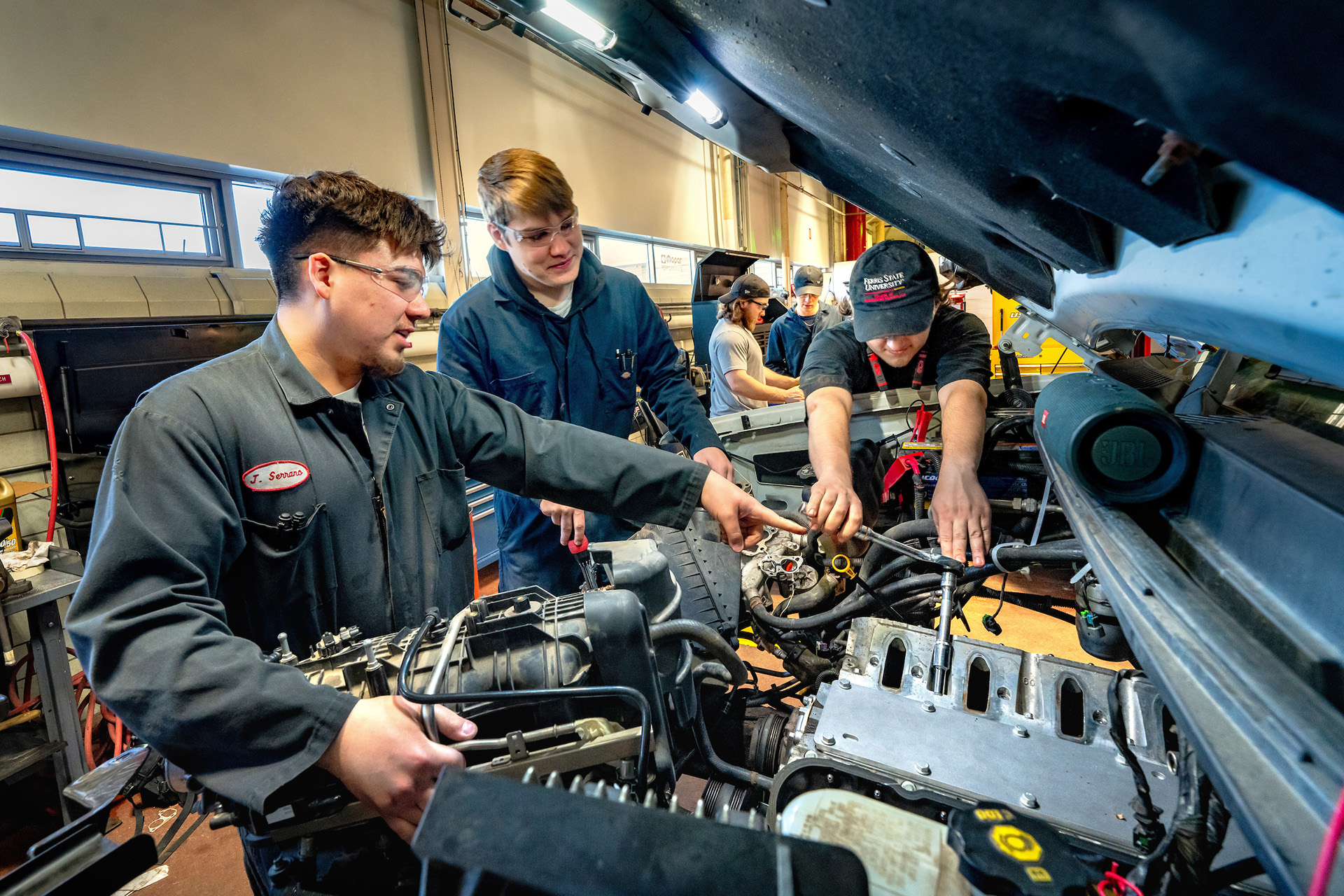
are pictured working.
BIG RAPIDS, Mich. —
Ferris State University is emerging as a national leader in sustainable transportation
technology with a new program aimed at preparing students for careers in the rapidly
changing and growing field.
Ferris State’s leadership is recognized around the country, with the College of Engineering
Technology recently hosting a three-day training session in electric vehicle technology
that attracted instructors from coast to coast.
The Sustainable Transportation Technology program will debut this fall and is funded
in part by a National Science Foundation grant.
“Basically, we’re working to mirror what we know is and will be needed in business
and industry for sustainable transportation,” said Patrick English, a professor in
the School of Automotive and Heavy Equipment. “One aspect of this we’re particularly
excited about is that this is born out of our partnership with business and industry
that will help ensure we’re educating students to be ready to meet the demands.”
Through a collaborative effort, Ferris State has positioned its Automotive Center
as home to a future program that will include sections on electricity and other alternative
solutions for powering vehicles that have, are and will emerge.
“We’re confident that the Sustainable Transportation Technology program is a degree
that will never become dated because it’s always tracking business and industry,”
English said. “We’re working to make it as part of the two-plus-two where you can
start in Sustainable Transportation Technology and finish with a bachelor’s degree
in our Automotive Engineering Technology program.”
Ferris State will offer students the opportunity to be trained to meet current and
future industry and business requirements.
“The students we train go on to fill essential, highly skilled roles in the automotive
industry, in Michigan and across the United States,” English said. “It doesn’t matter
what the powertrain of the future is. At the Ferris State Automotive program, we will
make sure that our graduates can make a living with it.”
Sustainability is one of the four pillars of Ferris State’s 2024-2027 Strategic Plan.
Ferris State is quickly building a national reputation for its commitment to sustainable
transportation.
Ferris State this month hosted EV Level 4 training on the Big Rapids campus, welcoming
instructors from Maine to Oregon, and extending internationally into Canada.
Level 4 training focuses on advanced diagnostics, testing and the repair of electric
and hybrid vehicle systems.
“Well, this is Level 4 training – I’ve passed Level 1, 2 and 3,” said Russ Hutton,
a hybrid and electrified vehicle specialist visiting from Denver, Colorado. “The biggest
thing is to enhance my knowledge on the charging side. There’s a big shortage of technicians.
I want to understand how they really work and how the car and charging station communicate
to each other.”
Instructors visiting Big Rapids from a wide range of higher education institutions
appreciated the opportunity.
Dustin Godbolt is an automotive instructor at Florence-Darlington Technical College
in Florence, South Carolina.
“We’re just starting out with our electric vehicle program, and we thought this would
help with our work to get it kick started,” he said. “We jumped on the opportunity
to take part in this training when we heard it was being offered.”
The strong turnout for the Level 4 training showed colleges and universities are beginning
to take notice of the possibilities with sustainable transportation academic programs.
Ferris State is a hub for training educators. That knowledge will be available to
students.
English is confident in the job opportunities highly trained graduates will see.
“They will be able to work at places that are not only dealerships for electric vehicles,
but we’re also seeing more independents that are working with electric vehicles and
hybrids,” he said. “Our graduates will be successful in those areas, too.”
He loves that Ferris State is helping lead the way in training students.
“Being innovative is what Ferris State has done all along, going back to Woodbridge
Ferris,” English said. “This is one of the newest technologies. We are looking at
what the market needs and we’re adapting to make sure our students are prepared to
meet the demands.”
He added, “The new program contains concepts related to electric vehicles and fuel
cells, helping graduates prepare for successful work in the sustainable transport
industry, even as fueling methods and power strategies change.”
English noted the words of Ferris State President Bill Pink.
“As Dr. Pink would say, it’s about being relevant and responsive,” English said. “We
want to be relevant and responsive to what we know employers want and need. We need
to offer something that’s relevant to our students and to business and industry.”
link