


Key Highlights
| Study Period | 2019 – 2032 |
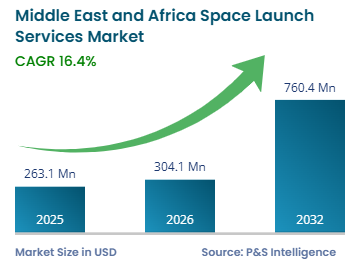
| Market Size in 2025 | USD 263.1 Million |
| Market Size in 2026 | USD 304.1 Million |
| Market Size by 2032 | USD 760.4 Million |
| Projected CAGR | 16.4% |
| Largest Country | Saudi Arabia |
| Fastest-Growing Country | UAE |
| Market Structure | Semi-Consolidated |
Market Size

Explore the market potential with our data-driven report
Middle East and Africa Space Launch Services Market Overview
The Middle East and Africa space launch services market size will be an estimated USD 263.1 million for 2025, and it will grow by 16.4% during 2026–2032, to reach USD 760.4 million by 2032.
This remarkable growth trajectory reflects the region’s accelerating investment in space infrastructure, emerging national space programs, and increasing demand for satellite-based services. The expansion is primarily driven by ambitious government-backed space initiatives in countries such as the United Arab Emirates, Saudi Arabia, and Egypt, alongside growing commercial interest in space technologies for telecommunications, earth observation, and navigation applications. The MEA region is witnessing a transformative shift in its space sector, with several countries establishing dedicated space agencies and launching comprehensive national space strategies.
Moreover, the deployment of satellite constellations for broadband connectivity, earth observation, and IoT applications requires frequent launches, creating sustained demand for launch services in the region.
Saudi Arabia’s plans include significant investments in satellite navigation systems, rocket manufacturing, and earth observation technologies. As reported by regional market studies, small satellites and advanced sensing systems represent key growth areas, with applications spanning agriculture, urban planning, disaster management, and national security. This diverse application landscape ensures continued growth in launch service demand as countries seek to deploy specialized satellites for various national priorities.
Middle East and Africa Space Launch Services Market Segmentation Analysis
Payload Type Analysis
The satellites category holds the largest market share, of 70%, in 2025, due to the region’s increasing focus on deploying communication satellites, earth observation systems, and navigation satellites to support national development objectives. Countries across the MEA region are investing heavily in satellite technology to enhance telecommunications infrastructure, monitor natural resources, and improve disaster management capabilities. The proliferation of small satellite technology has made space access more affordable for emerging space nations, with several countries planning to deploy nano and microsatellites for various applications, including environmental monitoring, border surveillance, and agricultural assessment.
The testing probes category will have the highest CAGR, of 16.6%, driven by the increasing scientific research initiatives and the establishment of dedicated space science programs across the region. Countries are launching testing probes to validate new technologies, conduct atmospheric research, and prepare for more ambitious space missions. The growing emphasis on indigenous technology development and the need to test components in space environments before full-scale satellite deployment are key factors driving this segment’s growth.
The payload types analyzed in this report are:
- Satellites (Largest Category)
- Human Spacecraft
- Cargo
- Testing Probes (Fastest-Growing Category)
- Stratollites
Service Type Analysis
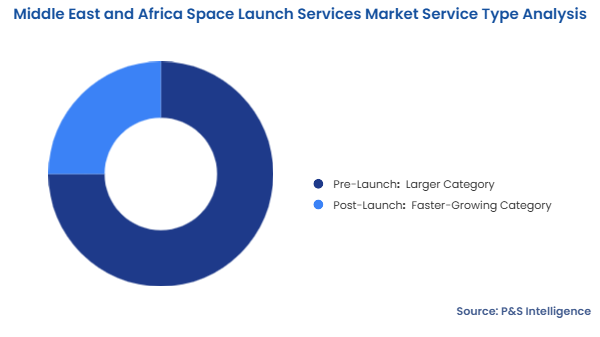
The pre-launch category holds the larger market share, of 75%, in 2025. This segment’s dominance stems from the comprehensive nature of pre-launch activities required in the region, including payload integration, mission planning, regulatory compliance, and ground infrastructure preparation. The complexity of international launch arrangements, combined with the need for extensive testing and verification procedures, contributes to the high value of pre-launch services.
The post-launch category will have the higher CAGR, of 16.7%, driven by the increasing number of satellites being deployed by MEA countries and the corresponding need for comprehensive post-launch support, including orbit insertion verification, telemetry tracking, and initial operational support. The establishment of regional ground stations and satellite control centers has created new opportunities for post-launch service providers.

The service types analyzed in this report are:
- Pre-Launch (Larger Category)
- Post-Launch (Faster-Growing Category)
Launch Vehicle Analysis
The heavy category holds the largest market share, of 55%, in 2025. This dominance reflects the region’s preference for launching larger, more sophisticated satellites that require greater lift capacity. Heavy launch vehicles are essential for deploying advanced communication satellites, large earth observation platforms, and multiple satellite constellations in a single mission. The segment benefits from established partnerships with international launch service providers who operate proven heavy-lift vehicles, offering reliability and mission assurance crucial for high-value payloads.
The medium category will have the highest CAGR, driven by the increasing adoption of medium-sized satellites and the growing trend toward dedicated launches for specific missions. Medium launch vehicles offer an optimal balance between capability and cost, making them attractive for countries developing their initial satellite programs. The flexibility to launch single large satellites or multiple smaller satellites provides mission planners with various deployment options, driving demand in this segment.
The launch vehicles analyzed in this report are:
- Small
- Medium (Fastest-Growing Category)
- Heavy (Largest Category)
Orbit Type Analysis
The low earth orbit category holds the largest market share in 2025, driven by the increasing deployment of LEO satellite constellations for telecommunications, earth observation, and IoT applications across the region. LEO satellites offer significant advantages, including lower latency, reduced launch costs, and the ability to provide better coverage for mobile and broadband services. The proliferation of small satellites and CubeSats, which predominantly operate in LEO, has made space access more affordable for emerging space nations in the region.
The medium earth orbit category will have the highest CAGR. This rapid expansion is primarily attributed to the growing demand for navigation and positioning services, as MEO is the preferred orbit for global navigation satellite systems. Countries in the MEA region are investing in regional navigation systems to reduce dependence on foreign GNSS providers and enhance national security capabilities. The segment benefits from MEO’s optimal balance between coverage area and signal strength, making it ideal for navigation, timing, and positioning applications critical for various sectors, including transportation, agriculture, and defense.
The orbit types analyzed in this report are:
- Low Earth Orbit (Largest Category)
- Medium Earth Orbit (Fastest-Growing Category)
- Geosynchronous Earth Orbit
- Others
End User Analysis
The government & military category holds the larger market share, of 65%, in 2025, driven by national space programs, defense applications, and government-led initiatives for economic development through space technology. Governments across the region are the primary investors in space infrastructure, funding satellite programs for national security, border surveillance, resource monitoring, and disaster management. Military applications, including secure communications, intelligence gathering, and navigation systems, represent significant drivers of government demand for launch services.
The commercial category will have the higher CAGR, of 16.8%, fueled by the commercialization of space activities, with private companies entering the market for telecommunications, broadcasting, and earth observation services. The establishment of entities like Saudi Arabia’s Neo Space Group and commercial partnerships in the UAE demonstrate the region’s commitment to developing a vibrant commercial space sector.
The end users analyzed in this report are:
- Government & Military (Larger Category)
- Commercial (Faster-Growing Category)
Drive strategic growth with comprehensive market analysis
Middle East and Africa Space Launch Services Market Regional Outlook
Saudi Arabia Space Launch Services Market Size
Saudi Arabia holds the largest market share, of 35%, in 2025, driven by the Kingdom’s dominant position underpinned by its ambitious Vision 2030 objectives and substantial investments in space technology infrastructure.
According to the Communications, Space and Technology Commission, the Kingdom has identified five opportunity clusters, including satellite manufacturing, launch services, ground infrastructure, satellite communications, and earth observation. The country’s strategic focus on localizing space technology, combined with partnerships with international space agencies and investment in human capital development, positions Saudi Arabia to capture a significant portion of the regional launch services market while reducing dependence on foreign providers.
UAE Space Launch Services Market Size
UAE will have the highest CAGR, of 16.5%, driven by the country’s established space program, strategic international partnerships, and commitment to developing a comprehensive space ecosystem.
The UAE’s competitive advantages include its advanced infrastructure, strategic geographic location, and proactive regulatory environment that attracts international space companies. The country has successfully positioned itself as a regional hub for space activities, hosting the UAE Space Agency and numerous commercial space ventures. With investments in ground stations, satellite manufacturing capabilities, and partnerships with global space leaders, the UAE is creating a comprehensive value chain that supports sustained growth in launch services demand. The country’s focus on developing indigenous capabilities while maintaining strong international collaborations ensures continued momentum in its space sector development.
The countries of the market are as follows:
- Saudi Arabia (Largest Country Market)
- UAE (Fastest-Growing Country Market)
- Kuwait
- Qatar
- Bahrain
- Egypt
- South Africa
- Rest of MEA
Middle East and Africa Space Launch Services Market Share
The market is semi-consolidated with international players dominating service provision while regional entities focus on developing indigenous capabilities and managing procurement relationships. The market concentration reflects the technical complexity and capital-intensive nature of launch services, where established global providers maintain significant advantages in technology, infrastructure, and operational experience. However, the landscape is evolving rapidly as regional players emerge through government initiatives and public-private partnerships, creating a more diverse competitive environment. Strategic activities shaping the competitive landscape include joint ventures for technology transfer, long-term launch service agreements, and investments in regional infrastructure.
Key Middle East and Africa Space Launch Services Companies:
- UAE Space Agency
- Egyptian Space Agency (EgSA)
- SpaceX
- China Great Wall Industry Corporation
- Hindustan Aeronautics Limited
- CAS Space
- Arianespace
- Mitsubishi Heavy Industries
- Space Pioneer
- Axelspace Corporation
- KT Sat Co., Ltd.
- Intellian Technologies, Inc.
link