Digital twins and Big AI: the future of truly individualised healthcare
Foundational Research Gaps and Future Directions for Digital Twins | National Academies. https://www.nationalacademies.org/our-work/foundational-research-gaps-and-future-directions-for-digital-twins.
Coveney, P. V. & Highfield R. Virtual You: How Building Your Digital Twin Will Revolutionize Medicine and Change Your Life. (Princeton University Press, 2023).
Laubenbacher, R. et al. Toward mechanistic medical digital twins: some use cases in immunology. Front. Digit. Health 6, 1349595 (2024).
Google Scholar
Wu, C. et al. Integrating mechanism-based modeling with biomedical imaging to build practical digital twins for clinical oncology. Biophys. Rev. 3, 021304 (2022).
Lo, S. C. Y. et al. A multi-component, multi-physics computational model for solving coupled cardiac electromechanics andvascular haemodynamics. Comp. Meth. Appl. Mech. Eng. 446, 118185 (2025).
Lin, M. & Stahlberg, E. The First Virtual Human Global Summit: Prepublication Meeting Report. (2023) https://doi.org/10.2172/2428904.
Coveney, P. V. & Highfield, R. Artificial intelligence must be made more scientific. J. Chem. Inf. Model. 64, 5739–5741 (2024).
Google Scholar
Guillory, D., Shankar, V., Ebrahimi, S., Darrell, T. & Schmidt, L. Predicting With Confidence on Unseen Distributions. In proc. of the IEEE/CVF International Conference on Computer Vision 1134–1144 (2021).
Dominguez-Gomez, P. et al. Fast and accurate prediction of drug induced proarrhythmic risk with sex specific cardiac emulators. Npj Digit. Med. 7, 1–18 (2024).
Li, X., Liu, X., Deng, X. & Fan, Y. Interplay between Artificial Intelligence and Biomechanics Modeling in the Cardiovascular Disease Prediction. Biomedicines 10, 92157 (2022).
Zhang, X. et al. Combining physics-based models with deep learning image synthesis and uncertainty in intraoperative cone-beam CT of the brain. Med. Phys. 50, 2607–2624 (2023).
Lee, J. H., Gao, H. & Döllinger, M. Integrating machine learning with physics-based modeling of physiological systems. Front. Physiol. 16, 1-3, (2025)
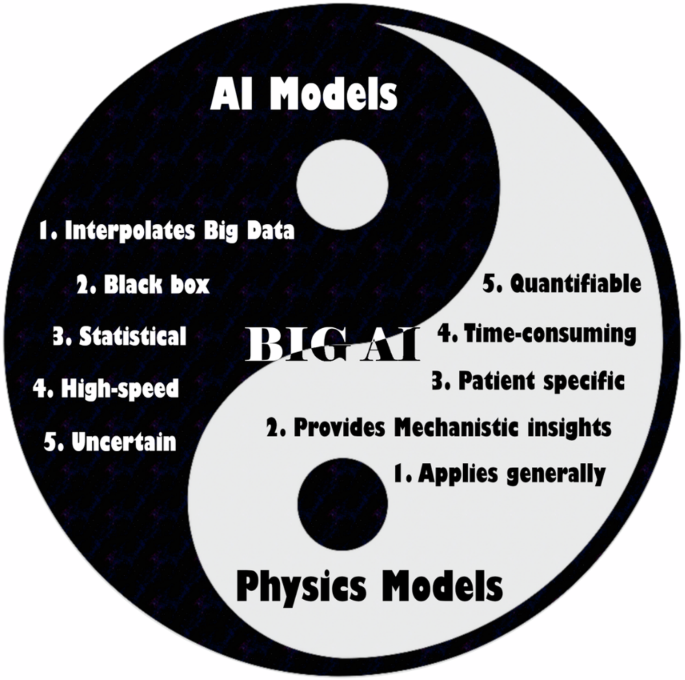
Coveney, P. V. & Highfield, R. Big AI: Blending Big Data with Big Theory to Build Virtual Humans. in Artificial Intelligence for Science 381–398 (World Scientific, 2022). https://doi.org/10.1142/9789811265679_0021.
Fia, W. Reflection paper on the use of artificial intelligence (AI) in the medicinal product lifecycle. European Medicines Agency. (2023).
US Food and Drug Administration. Assessing the Credibility of Computational Modeling and Simulation in Medical Device Submissions – Guidance for Industry and Food and Drug Administration Staff. https://www.fda.gov/media/154985/download.
US Food and Drug Administration. Using Artificial Intelligence & Machine Learning in the Development of Drug & Biological Products. https://www.fda.gov/media/167973/download.
Schlander, M., Hernandez-Villafuerte, K., Cheng, C.-Y., Mestre-Ferrandiz, J. & Baumann, M. How much does it cost to research and develop a new drug? A systematic review and assessment. Pharm. Econom. 39, 1243–1269 (2021)
McLoughlin, K. S. et al. Generative Molecular Design and Experimental Validation of Selective Histamine H1 Inhibitors. 2023.02.14.528391 Preprint at (2023).
Wan, S., P. Bhati, A., D. Wade, A., Alfè, D. & V. Coveney, P. V. Thermodynamic and structural insights into the repurposing of drugs that bind to SARS-CoV-2 main protease. Mol. Syst. Des. Eng. 7, 123–131 (2022).
Coveney, P. V. COMbining Deep-Learning with Physics-Based AffinIty EstimatiOn 3 (COMPBIO3). https://www.alcf.anl.gov/science/projects/combining-deep-learning-physics-based-affinity-estimation-3-compbio3.
Reichstein, M. et al. Deep learning and process understanding for data-driven Earth system science. Nature 566, 195–204 (2019).
McGovern, A. et al. Using Artificial Intelligence to Improve Real-Time Decision-Making for High-Impact Weather. (2017) https://doi.org/10.1175/BAMS-D-16-0123.1.
Sadowski, P., Fooshee, D., Subrahmanya, N. & Baldi, P. Synergies between quantum mechanics and machine learning in reaction prediction. J. Chem. Inf. Mod. 56, 2125–2128 (2016).
Font, B., Alcántara-Ávila, F., Rabault, J., Vinuesa, R. & Lehmkuhl, O. Deep reinforcement learning for active flow control in a turbulent separation bubble. Nat. Commun. 16, 1422 (2025).
Scientific Knowledge with Machine Learning for Engineering and Environmental Systems | ACM Computing Surveys.
link