Grand Challenges: Driving the future of smart, sustainable mobility – Today@Wayne

From the heart of the Motor City, Wayne State is continuing Detroit’s legacy of transforming transportation through research that improves safety, reduces emissions and expands access. Through its Grand Challenges initiative, Wayne State is uniting experts to create personalized solutions and shape the future of mobility in our rapidly evolving world.

Across campus, researchers are working on electric vehicles and autonomous systems, infrastructure and policy changes, next-generation materials, and more equitable public transit. Much of Wayne State’s mobility-related research is associated with one of the university’s research groups, including the Center for Electric, Connected and Autonomous Technologies (eCAT), the Transportation Research Group, and the Center for Automotive Research.
“Wayne State’s mobility research aims to unite Detroiters and industry, driving innovation that ultimately moves communities forward,” said Dr. Ezemenari M. Obasi, vice president for research & innovation. “We are rooted in the Motor City that put the world on wheels, and through our Grand Challenges initiative, we’re shaping a future where we are driving cutting-edge advancements in mobility in a way that is accessible to all.”
Autonomous, connected and intelligent systems
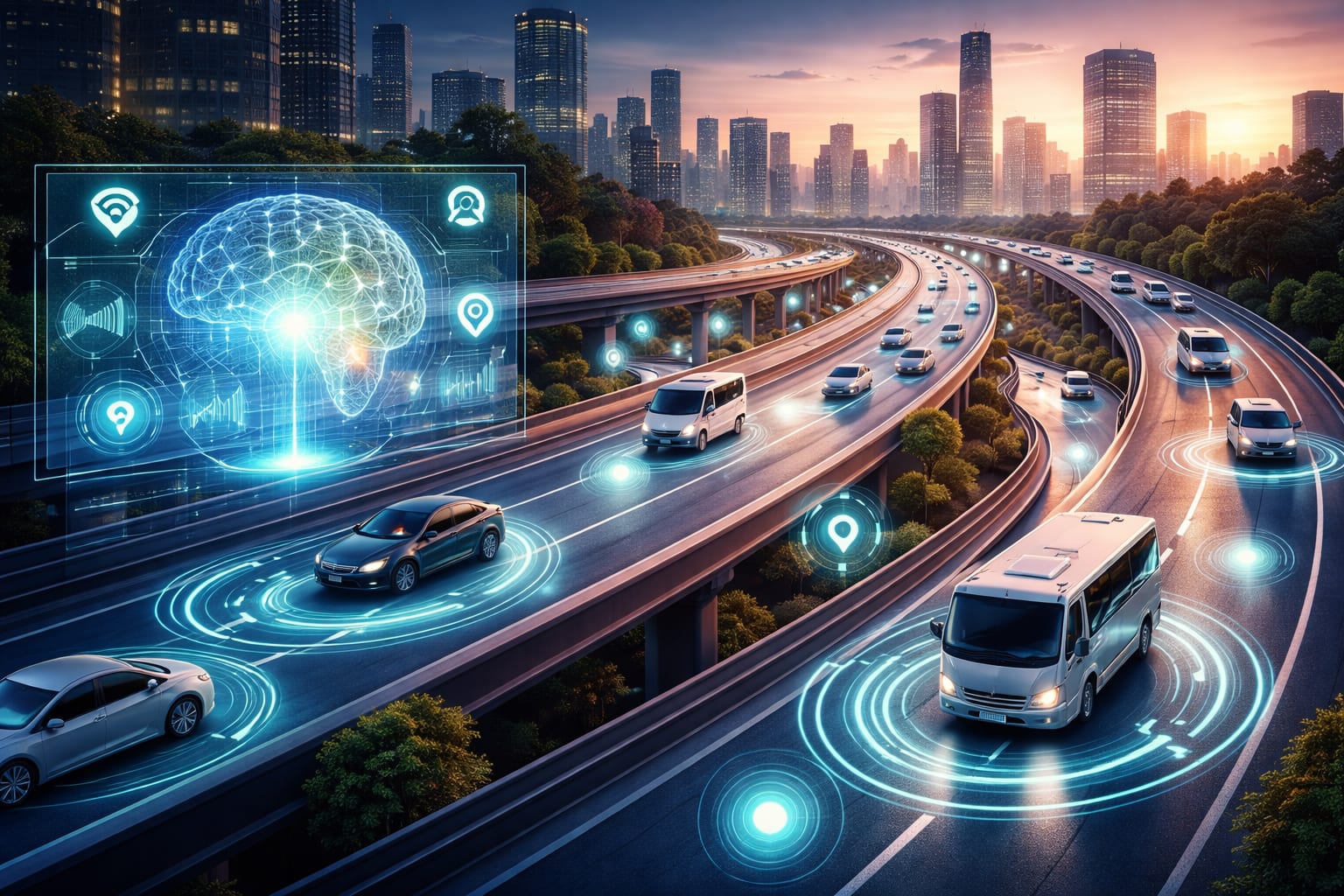
Mobility drives the pace of everyday life, and today, the transportation landscape is undergoing a profound transformation driven by rapid advances in autonomous systems — from connected vehicles to commercial drones. These technologies promise greater operational efficiency and the emergence of entirely new modes of travel. WSU researchers are at the forefront of this transition, working to make intelligent machines safer, more effective and more responsive. In the James and Patricia Anderson College of Engineering, Associate Professor of Computer Science Dr. Zheng Dong leads efforts to enhance the safety and reliability of autonomous systems, ensuring they can interact seamlessly with human drivers and navigate the complexities of modern urban environments.
“We are in a new era of artificial intelligence, where deep neural networks are transforming the perception pipeline, path-planning and control algorithms of autonomous vehicles. These advances are opening new frontiers in real-time embedded systems research and demanding novel solutions to ensure that such systems remain safe and effective,” said Dong. “By leveraging these powerful AI technologies, human innovation and creativity can be further amplified in this field. We hope our research lays a solid foundation for the development of safe and effective autonomous vehicle and machine systems.”
Work in this area is taking Wayne State to new heights in other ways, as well. Dr. Yanchao Liu, assistant professor of industrial and systems engineering, is advancing next-generation commercial drone technologies with applications in logistics, agriculture, public safety, and national defense. Building on his high-density aerial traffic management framework, Liu’s research has helped position Wayne State University as a leader in autonomous mobility systems. This expertise recently contributed to a major achievement: Airspace Experience Technologies (ASX), a long-standing industry partner of Liu’s lab, secured a contract from the U.S. Department of the Air Force to demonstrate a joint command system that could manage automated air and ground vehicles at multiple Air National Guard installations.

“This partnership represents an exciting opportunity to translate years of theoretical research into real-world impact,” said Liu. “Our work in high-density aerial traffic management has always been driven by a vision of safer, more efficient, and more equitable mobility.”
Almost all modern technologies are dependent on the semiconductor industry, and Dr. Charles Winter, professor of chemistry in the College of Liberal Arts and Sciences, has led research that dramatically improved the speed, power and efficiency of next-generation computer chips that power the artificial intelligence behind self-driving cars and other advanced machines.
Sustainable energy, next-generation batteries and electric mobility

Wayne State is also at the forefront of the clean transportation transition — the shift away from fossil fuels. The Center for Electric, Connected and Autonomous Technologies (eCAT), led by Dr. Caishang Wang, professor of electrical and computer engineering in the James and Patricia Anderson College of Engineering, is advancing research in sustainable energy systems, electric vehicle infrastructure and smart grid integration. ECAT is a National Science Foundation Industry-University Cooperative Research Center, tasked with developing sustainable mobility technologies such as V2X (vehicle-to-everything) communications and real-time edge computing.
WSU is also at the forefront of research on cleaner, more efficient energy storage for electric vehicles. Dr. Leela Arava, professor of mechanical engineering and associate dean for research and graduate studies, leads research focused on high-energy, rechargeable lithium-sulfur (Li/S) batteries, which can store five times more energy than their lithium-ion counterparts and are set to be the next generation of batteries. Assistant Professor of Mechanical Engineering Dr. Mahbub Islam’s research focuses on magnesium-carbon dioxide batteries, which use abundant, low-cost magnesium and convert carbon dioxide into electricity.

He stresses how crucial this research is for advancing efficient battery technologies and promoting environmental sustainability — efforts that stand to impact millions, if not billions, of people worldwide.
“Electrochemical energy storage is vital for harnessing energy from intermittent renewables like solar and wind and electrifying the transportation sector to achieve a carbon-neutral future. Current lithium batteries, while offering high energy densities, encounter challenges related to scarcity, geopolitical issues and the high cost of lithium. Therefore, alternative energy storage technologies that utilize low-cost, environmentally friendly materials are necessary to facilitate the transition to a sustainable energy future.”
Safer, smarter and more equitable transportation
Beyond technology, Wayne State’s research is improving the ways people travel and connect. For example, WSU’s Transportation Research Group. conducts research on a broad spectrum of mobility areas, including pedestrian safety, safety belt and child car seat use, transit wheelchair lifts, traffic signals, speed limits, heavy-duty trucks, bicycle safety, and more.
Meanwhile, researchers are also using artificial intelligence to enhance public transportation — from optimizing public transit routes for hourly workers to developing data-driven solutions that improve accessibility for people with disabilities. Dr. Xiaodong Qian, assistant professor of civil and environmental engineering, is leading research to develop a real-time crowdsourcing tool to collect, analyze and respond to public feedback about everything from routes and safety to cleanliness and reliability on transit services using AI.
A hub for collaboration and innovation
Wayne State’s leadership in mobility research reflects Detroit’s unique strengths — a city where the auto industry, public sector and researchers work together to test and deploy next-generation technologies. Mobility research at Wayne State blends technical innovation with real-world impact, and faculty from all disciplines are encouraged to engage with the Grand Challenges initiative.
link