Transportation Technology Market | Industry Report, 2033
Transportation Technology Market Summary
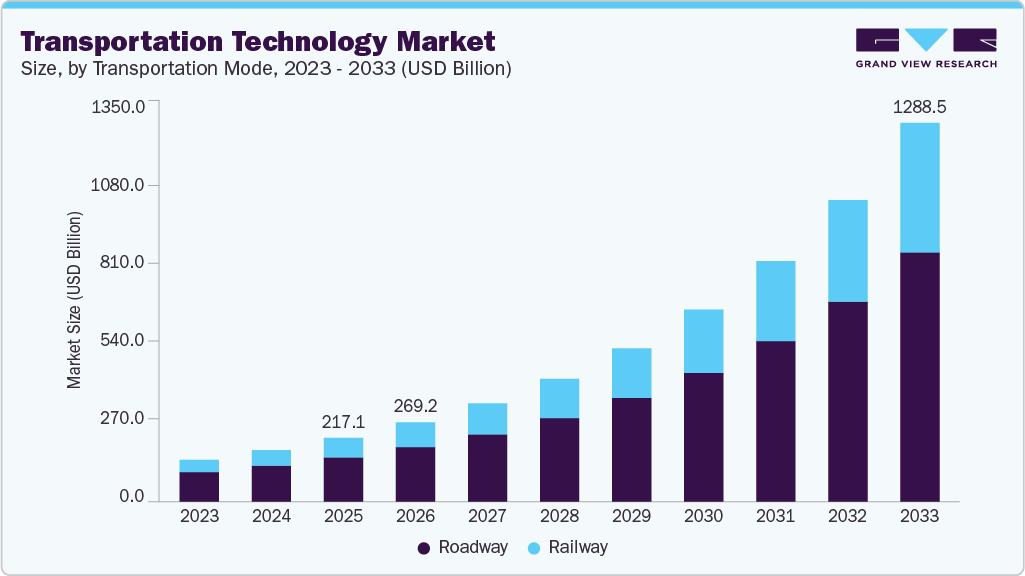
The global transportation technology market size was estimated at USD 217.10 billion in 2025 and is projected to reach USD 1,288.53 billion by 2033, growing at a CAGR of 25.1% from 2026 to 2033, driven by rapid urbanization and the intensifying need for efficient, safe, and sustainable mobility systems. Expanding metropolitan populations are placing significant pressure on existing transport infrastructure, leading governments and private operators to invest heavily in smart traffic management systems, real-time monitoring platforms, and integrated mobility solutions.
Key Market Trends & Insights
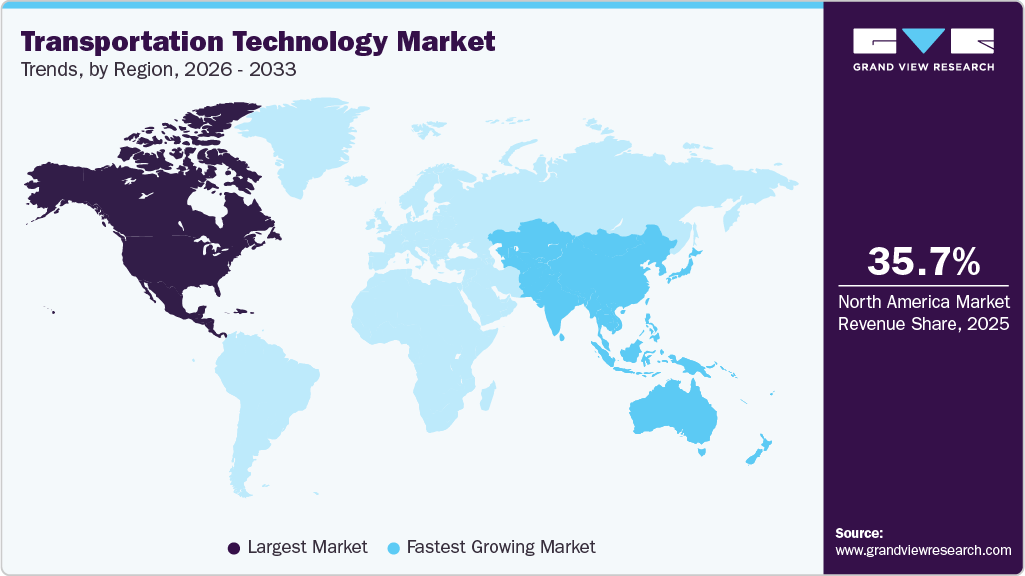
- North America dominated the global transportation technology market with the largest revenue share of 35.7% in 2025.
- The transportation technology industry in the U.S. accounted for the largest market revenue share in North America in 2025.
- By transportation mode, the roadway segment led the market with the largest revenue share of 69.4% in 2025.
- By roadway end use, the highways segment accounted for the largest market revenue share in 2025.
- By railway end use, the logistics management segment is expected to grow at the fastest CAGR over the forecast period .
Market Size & Forecast
- 2025 Market Size: USD 217.10 Billion
- 2033 Projected Market Size: USD 1,288.53 Billion
- CAGR (2026-2033): 25.1%
- North America: Largest market share in 2025
- Asia Pacific: Fastest growing market
Expanding metropolitan populations are placing significant pressure on existing transport infrastructure, leading governments and private operators to invest heavily in smart traffic management systems, real-time monitoring platforms, and integrated mobility solutions.
The rise of smart cities has further accelerated the adoption of technologies such as intelligent transportation systems (ITS), connected traffic signals, and data-driven route optimization, all of which aim to reduce congestion, improve travel time reliability, and enhance overall urban mobility performance.
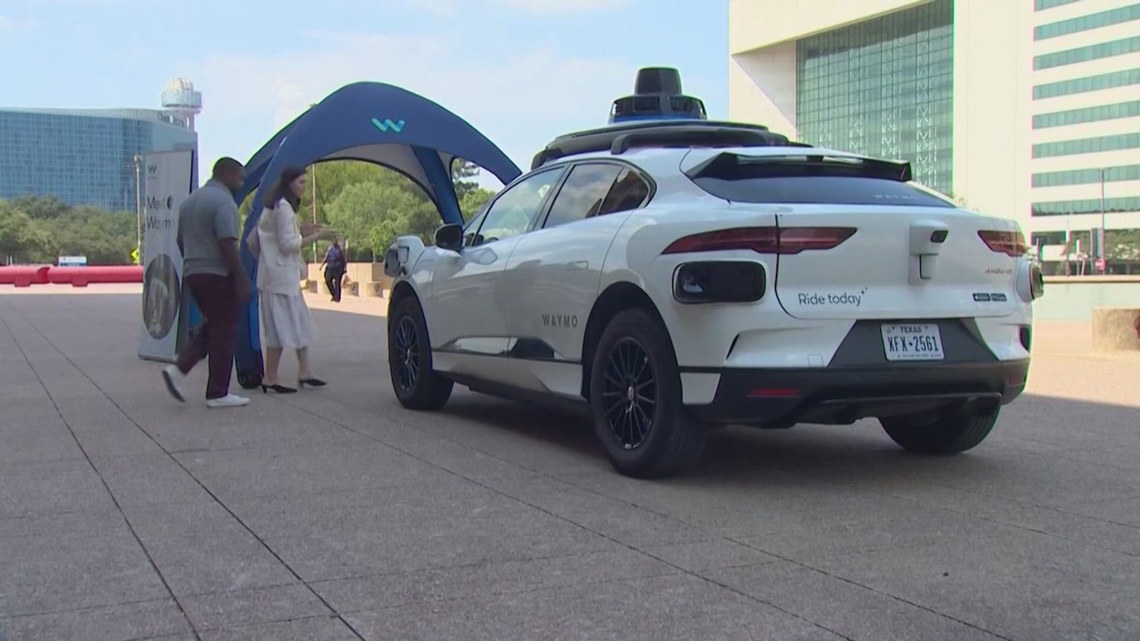
Moreover, the accelerating transition toward electric and autonomous vehicles also contributes to the transportation technology industry. Stricter emission regulations, coupled with strong government incentives for clean mobility, are boosting demand for advanced transportation technologies such as vehicle-to-everything (V2X) communication, advanced driver assistance systems (ADAS), and AI-powered navigation platforms. Automakers, logistics providers, and fleet operators are increasingly integrating sensor-based systems, machine learning analytics, and cloud connectivity to enhance safety, operational efficiency, and predictive maintenance, thereby expanding the broader transportation technology ecosystem.
The rapid digitalization of logistics and supply chain operations is also fueling market growth. E-commerce expansion, same-day delivery expectations, and global trade complexity are pushing companies to adopt technologies such as real-time tracking, automated warehousing, route analytics, and digital freight platforms. The integration of the Internet of Things (IoT), big data analytics, and blockchain into transportation networks is improving visibility, reducing operational costs, and minimizing delays, making technology adoption a strategic necessity rather than an optional investment.
Transportation Mode Insights
The roadway segment led the market with the largest revenue share of 69.4% in 2025. The growth of connected and autonomous vehicles is strengthening demand for smarter roadway systems. Modern vehicles rely on digital infrastructure to share real-time information on traffic flow, signals, and potential hazards. Technologies such as vehicle-to-infrastructure communication, smart intersections, and edge computing support continuous data exchange between vehicles and traffic control networks. As vehicle automation increases, governments and transport authorities are upgrading road systems to ensure compatibility, accelerating the adoption of advanced roadway transportation technologies.
The railway segment is anticipated to grow at the fastest CAGR during the forecast period. The growth of urban metro and light rail networks is boosting demand for railway transportation technologies. As cities become more congested, governments are prioritizing mass transit solutions that can efficiently move large numbers of passengers. Newly developed rail systems are increasingly built with digital infrastructure, including smart signaling, real-time passenger information, and automated ticketing. These technologies help improve reliability, reduce delays, and enhance the commuter experience. The trend is especially visible in developing economies, where large-scale rail investments are accelerating the adoption of modern transportation technologies.
Roadway Technology Insights
The road asset management segment accounted for the largest market revenue share in 2025. Growing pressure to use public funds more efficiently is driving the adoption of infrastructure asset management technologies. Budget constraints are pushing governments to rely on data-based tools that assess road conditions and maintenance needs. These platforms enable more strategic spending by prioritizing critical repairs and avoiding unnecessary costs. Better financial planning also improves transparency and helps agencies justify investments to stakeholders. As fiscal pressures rise, demand for such digital asset management solutions continues to increase.
The structural health monitoring segment is anticipated to grow at the fastest CAGR during the forecast period. The shift toward preventive and predictive maintenance is strengthening demand for structural health monitoring in transportation. Unlike reactive repairs, sensor-based monitoring continuously tracks asset conditions and supports predictive analytics. This helps agencies identify potential failures early, reduce downtime, and extend the lifespan of their infrastructure. Better maintenance planning also improves resource use and lowers emergency repair costs. With tighter budgets, transportation authorities are increasingly adopting these systems because they deliver clear cost savings and operational benefits.
Roadway End Use Insights
The highways segment accounted for the largest market revenue share in 2025, as governments and private operators increased spending on road expansion and digital upgrades. Rising traffic volumes and the need for better intercity connectivity are driving large-scale highway modernization programs. Beyond new construction, investments are increasingly directed toward smart infrastructure, including intelligent transportation systems, electronic tolling, and real-time traffic management tools to improve efficiency and safety.
The transport infrastructure segment is expected to grow at the fastest CAGR during the forecast period. Strong government support and public funding programs are driving growth in this segment. Major initiatives such as the U.S. Infrastructure Investment and Jobs Act, the EU’s TEN-T framework, and large infrastructure plans in China and India are channeling substantial investments into technologically advanced road projects. Additionally, policy incentives that promote sustainable construction and smart road solutions are further accelerating the adoption of modern transportation technologies.
Railway Technology Insights
The smart ticketing segment accounted for the largest market revenue share in 2025, as transport networks shift toward digital and contactless payments. Public authorities and transit operators are adopting these systems to speed up transactions, reduce cash dependency, and improve operational efficiency. Integration with mobile apps, wearables, and multi-modal platforms is further boosting adoption by enabling seamless, unified travel across different modes of transport.
The advanced navigation system segment is expected to grow at the fastest CAGR during the forecast period. The growing use of satellite-based navigation systems such as GPS, Galileo, and BeiDou is strengthening digital railway operations. GNSS enables precise train positioning and real-time tracking, supporting automation and more reliable scheduling. This improves punctuality and helps operators manage mixed passenger and freight traffic more efficiently. At the same time, rising demand for location-based services across industries is accelerating overall growth in the navigation satellite systems market, further supporting the adoption of rail technology.
Railway End Use Insights
The railway station segment accounted for the largest market revenue share in 2025, as stations evolve into smart, technology-driven mobility hubs rather than simple transit points. Adoption of digital infrastructure, such as real-time passenger information systems, automated ticketing, biometric access control, and centralized operations platforms are drivers. These investments help operators manage crowds more effectively, reduce train dwell times, and improve service reliability, especially in busy urban and intercity stations.
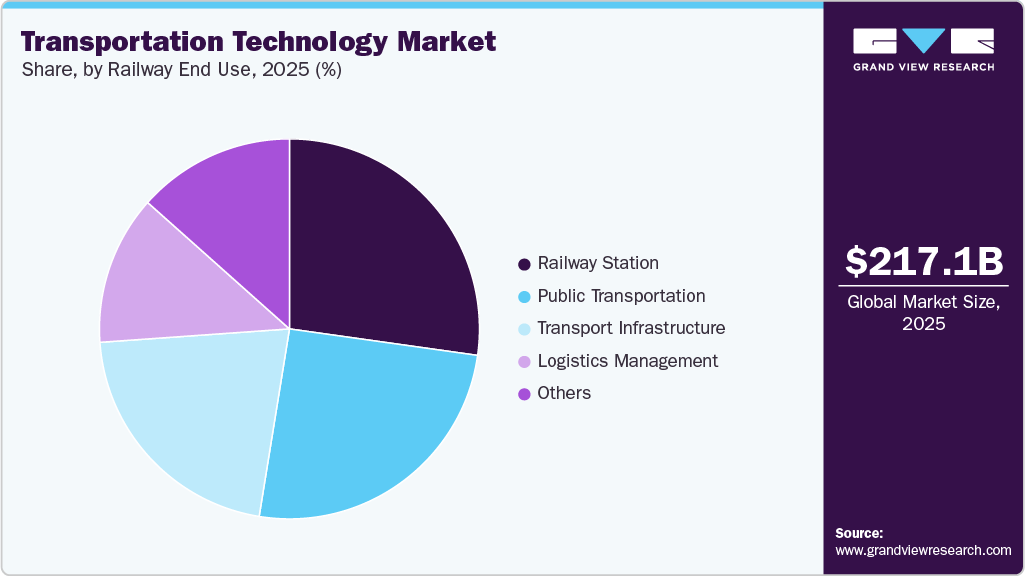
The logistics management segment is expected to grow at the fastest CAGR over the forecast period, as freight rail operations become more digital and data-driven. Rail operators and logistics providers are adopting integrated platforms to coordinate scheduling, asset tracking, inventory, and documentation across multi-modal supply chains. Real-time visibility into wagons, containers, and cargo conditions helps reduce delays, improve asset use, and limit disruptions, an increasingly critical capability as global trade volumes and operational complexity expand.
Regional Insights
North America dominated the global transportation technology market with the largest revenue share of 35.7% in 2025, driven by large-scale modernization of freight corridors and intermodal hubs, where technology is being deployed to increase capacity without proportionate physical expansion.
U.S. Transportation Technology Market Trends
The transportation technology market in the U.S. accounted for the largest market revenue share in North America in 2025, due tofederal infrastructure funding that prioritizes technology-enabled highways, particularly through pilot deployments of connected vehicle (V2X) corridors, smart traffic management systems, and data-sharing platforms between state DOTs. These initiatives are creating a standardized national framework for intelligent transportation, spurring private-sector investment in advanced roadway technologies.
Europe Transportation Technology Market Trends
The transportation technology market in Europe is anticipated to register at a considerable CAGR from 2026 to 2033, due to cross-border mobility integration under the TEN-T framework, which emphasizes seamless multimodal transport across rail, road, and inland waterways. Countries are investing in interoperable digital rail systems and harmonized signaling to remove operational bottlenecks between national networks, strengthening regional connectivity and freight efficiency.
The UK transportation technology market is expected to grow rapidly during the forecast period, driven by nationwide adoption of account-based ticketing and integrated mobility platforms that link rail, buses, and urban transit under unified digital payment systems. Rail authorities are also leveraging open data ecosystems to improve timetable reliability, crowd forecasting, and passenger experience across major transport corridors.
The transportation technology market in Germany held a substantial market share in Europe in 2025, driven by the application of Industry 4.0 principles to rail freight and logistics, with a strong emphasis on automated yards, digital twins of rail infrastructure, and predictive asset maintenance. Germany’s export-oriented economy is pushing technology upgrades that enhance freight punctuality and supply chain reliability.
Asia Pacific Transportation Technology Market Trends
The transportation technology market in the Asia Pacific is anticipated to grow at the fastest CAGR during the forecast period, as governments deploy technology-led mass transit solutions to manage extreme population density. Large-scale metro and BRT networks are being built with built-in digital control systems, real-time monitoring, and AI-based operations management from the outset.
The Japan transportation technology market is expected to grow rapidly during the forecast period. Demographic pressures from an aging population are encouraging greater automation in rail operations, station management, and maintenance. Advanced robotics, remote monitoring, and autonomous inspection systems are being adopted to reduce reliance on the workforce while maintaining Japan’s high safety and punctuality standards.
The transportation technology market in China held a substantial market share in the Asia Pacific in 2025, due to continued high-speed rail expansion and the deep integration of the BeiDou satellite system into national rail and road networks. China is prioritizing precision navigation, automated train control, and large-scale smart infrastructure projects that support both passenger mobility and freight logistics across vast distances.
Key Transportation Technology Company Insight
Key players operating in the transportation technology industry are Siemens AG, Hitachi, Ltd, NEC Corporation, Wabtec Corporation, Wabtec Corporation, and Conduent Business Services, LLC The companies are focusing on various strategic initiatives, including new product development, partnerships & collaborations, and agreements to gain a competitive advantage over their rivals.
Key Transportation Technology Companies:
The following key companies have been profiled for this study on the transportation technology market.
- Advantech Co., Ltd
- Almaviva S.p.A.
- Conduent Business Services, LLC
- Cubic Corporation
- ENGINEERING Ingegneria Informatica
- GMV Innovating Solutions
- Hitachi Rail Limited
- Hitachi, Ltd.
- IDEMIA
- Indra Sistemas, S.A.
- Kapsch TrafficCom
- NEC Corporation
- Vix Technology
- NTT DATA Group Corporation
- Q-Free ASA
- Siemens AG
- SWARCO
- Thales
- Wabtec Corporation
- Yunex Traffic
- Init SE
Recent Development
-
In December 2025, Hitachi, Ltd., partners with Google Cloud to apply advanced cybersecurity and AI technologies, speeding up innovation and efficiency in railway operations while pushing toward autonomous and sustainable trains.
-
In December 2025, Conduent Business Services, LLC launched Italy’s first integrated EMV contactless ticketing system, enabling seamless travel across multiple transit operators. The solution enhances fare payment, security, and interoperability, supporting digital transformation and improved passenger experience in the transportation technology industry.
-
In August 2025, SWARCO acquired Heusch/Boesefeldt GmbH, a leading provider of highway and tunnel management software, strengthening its DACH-region presence, advancing digital traffic infrastructure, and supporting CCAM, construction site management, and intelligent mobility solutions for national and international transport networks.
Transportation Technology Market Report Scope
|
Report Attribute
|
Details
|
|
Market size value in 2026
|
USD 269.24 billion
|
|
Revenue forecast in 2033
|
USD 1,288.53 billion
|
|
Growth rate
|
CAGR of 25.1% from 2026 to 2033
|
|
Base year for estimation
|
2025
|
|
Historical data
|
2021 – 2024
|
|
Forecast period
|
2025 – 2033
|
|
Quantitative units
|
Revenue in USD million/billion, and CAGR from 2026 to 2033
|
|
Report enterprise size
|
Revenue forecast, company share, competitive landscape, growth factors, and trends
|
|
Segments covered
|
Transportation mode, roadway technology, roadway end use, railway technology, railway end use, region
|
|
Regional scope
|
North America; Europe; Asia Pacific; Latin America; MEA
|
|
Country scope
|
U.S.; Canada; Mexico; UK; Germany; France; China; India; Japan; Australia; South Korea; Brazil; UAE; Saudi Arabia; South Africa
|
|
Key companies profiled
|
Advantech Co., Ltd; Almaviva S.p.A.; Conduent Business Services, LLC; Cubic Corporation; Init S;EENGINEERING Ingegneria Informatica; GMV Innovating Solutions; Hitachi Rail Limited; Hitachi, Ltd.; IDEMIA; Indra Sistemas, S.A.; Kapsch TrafficCom; NEC Corporation; NTT DATA Group Corporation; Q-Free ASA; Siemens AG; SWARCO; Thales; Vix Technology; Wabtec Corporation; Yunex Traffic
|
|
Customization scope
|
Free report customization (equivalent to 8 analysts working days) with purchase. Addition or alteration to country, regional & segment scope.
|
|
Pricing and purchase options
|
Avail customized purchase options to meet your exact research needs. Explore purchase options
|
Global Transportation Technology Market Report Segmentation
This report forecasts revenue growth at the global, regional, and country levels and provides an analysis of the latest industry trends in each of the sub-segments from 2021 to 2033. For this study, Grand View Research has segmented the global transportation technology market report based on transportation mode, roadway technology, roadway end use, railway technology, railway end use, and region.
-
Transportation Mode Outlook (Revenue, USD Billion, 2021 – 2033)
-
Roadway Technology Outlook (Revenue, USD Billion, 2021 – 2033)
-
Cooperative Intelligent Transport Systems (C-ITS)
-
Traffic Management Systems
-
Road Asset Management
-
Smart Road Infrastructure
-
Road surface technology/ Smart payment
-
Geographic Information System
-
Spatial Analysis
-
Mapping and Surveying
-
-
Remote Sensing Technology
-
Light Detection and Ranging (LiDAR)
-
Aerial & Satellite Imaging
-
Predictive Maintenance
-
Reporting & Analytics
-
-
Structural Health Monitoring
-
Decision Support System (DSS)
-
Policy & Regulation Compliance
-
Data Collection, Integration, and Analysis
-
-
Others
-
Advanced Navigation System
-
Traveler Information Systems
-
Route Guidance & Route Optimization
-
Electric Charging Infrastructure
-
On-demand Transit
-
Assistive Technology
-
-
-
Roadway End Use Outlook (Revenue, USD Billion, 2021 – 2033)
-
Bus Station
-
Highways
-
Transport Infrastructure
-
Logistics Management
-
Transportation
-
Others
-
-
Railway Technology Outlook (Revenue, USD Billion, 2021 – 2033)
-
Smart Ticketing
-
Passenger Information Systems
-
Automatic Fare Collection
-
Advanced Navigation System
-
Traveler Information Systems
-
Traffic Management System
-
Geographic Information System (GIS)
-
Predictive Maintenance
-
Rail Analytics
-
Assistive Technology
-
Asset Management
-
Smart Video Surveillance
-
Safety & Security Systems
-
Command and Control Systems (CCS)
-
Structural Health Monitoring
-
-
Railway End Use Outlook (Revenue, USD Billion, 2021 – 2033)
-
Railway Station
-
Public Transportation
-
Transport Infrastructure
-
Logistics Management
-
Others
-
-
Regional Outlook (Revenue, USD Billion, 2021 – 2033)
-
North America
-
Europe
-
Asia Pacific
-
China
-
India
-
Japan
-
South Korea
-
Australia
-
-
Latin America
-
Middle East & Africa
-
UAE
-
Saudi Arabia
-
South Africa
-
-
Frequently Asked Questions About This Report
b. The global transportation technology market size was estimated at USD 217.10 billion in 2025 and is expected to reach USD 269.24 billion in 2026.
b. The global transportation technology market is expected to grow at a compound annual growth rate of 25.1% from 2026 to 2033 to reach USD 1,288.53 billion by 2033.
b. The roadway segment dominated the market and accounted for the revenue share of 69.4% in 2025. The growth of connected and autonomous vehicles is strengthening demand for smarter roadway systems.
b. Key players operating in the transportation technology industry are Siemens AG, Hitachi, Ltd.., NEC Corporation, Wabtec Corporation, Wabtec Corporation, and Conduent Business Services, LLC.
b. The rise of smart cities has accelerated adoption of technologies such as intelligent transportation systems (ITS), connected traffic signals, and data-driven route optimization, all of which aim to reduce congestion, improve travel time reliability, and enhance overall urban mobility performance.
link